Marine Air Conditioning FAQs
Being one of the areas that we have the most experience in, we’ve decided to put together this handy marine air conditioner FAQ / guide with answers to many commonly asked questions on marine air conditioning systems for boats, yachts and sailboats. If looking for marine air conditioners for sale, see here: Marine Air Conditioners
What is Marine Air Conditioning?
Marine air conditioning not only cools your boat, but dehumidifies it, and if you have reverse cycle heating, will also provide heat during winter. Besides the cooler air, with marine air conditioning your boat will be drier, more comfortable, the onboard systems will be better taken care of, and you will be rewarded with less corrosion.
How Does a Marine Air Conditioner Work?
A boat air conditioner works differently than regular air conditioners because they use water rather than air for cooling the system. The abundance of water and lack of space make this preferable.
Marine air conditioners don’t really produce cold, they remove heat. As the phase-converting refrigerant expands and passes through the system’s evaporator coils, it gets colder because all refrigerating gases become cold and more gaseous when they expand, and absorb heat from the surrounding air. The unit’s fan circulates the warm air from the cabin across the cold evaporator and discharges it, now cooler, back through ducting back into the cabin. Also, an external raw water pump circulates water into the unit to dissipate all of the heat and then it is released back into the ocean.
What Are the Major Marine Air Conditioner Components?
While there are different marine air conditioning configurations, they all share Four major components: The evaporator, where boiling refrigerant absorbs heat from the surrounding air; the compressor, which pushes the expanded refrigerant throughout the system. The condenser, where the refrigerant is cooled and liquefied before being pumped back into the evaporator, and the blower fan to circulate the cold air through the unit
What Is a Self-Contained Marine Air Conditioner?
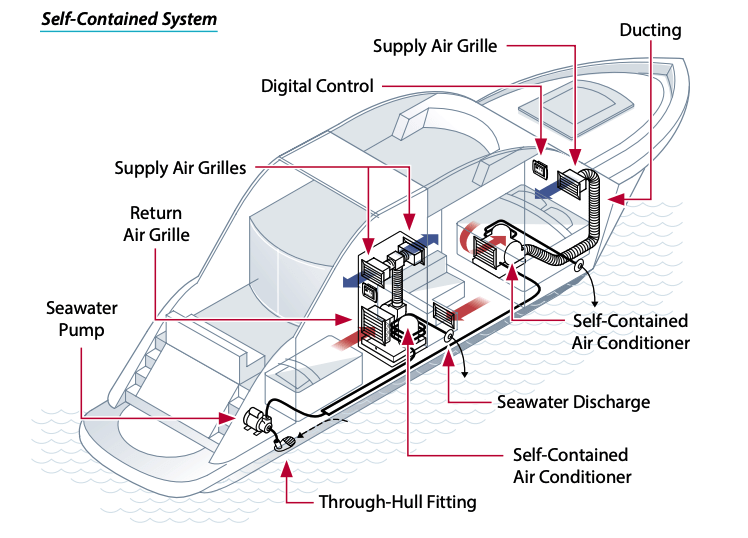
A self-contained marine air conditioner is a marine A/C unit where all of the major components are mounted on a single chassis, and is generally installed in the living area under a bunk, settee, or in a locker. They require thru-hull connections to draw cooling water into the unit, and use environmentally-friendly refrigerants such as R-417A or R-410A. Self-contained marine air conditioners are usually the best choice for boats up to 40′.
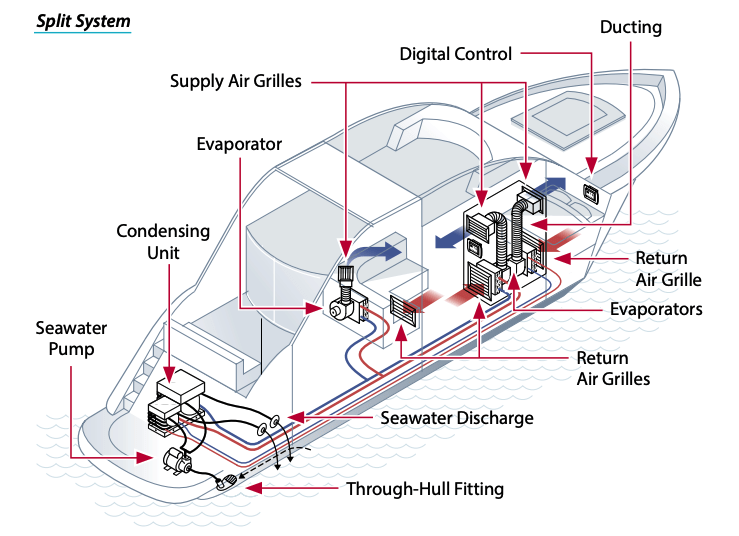
What Is Split Marine Air Conditioning?
Central marine air conditioning systems, also known as split systems, have the air conditioning components split between two separate units. The units are installed in different locations and are connected by insulated copper tubing, through which the refrigerant travels. The condensing unit (made up of a compressor, seawater condenser and electrical components) is generally mounted in the engine room, while the evaporator (including the evaporator coil and a blower) is installed in the living area.
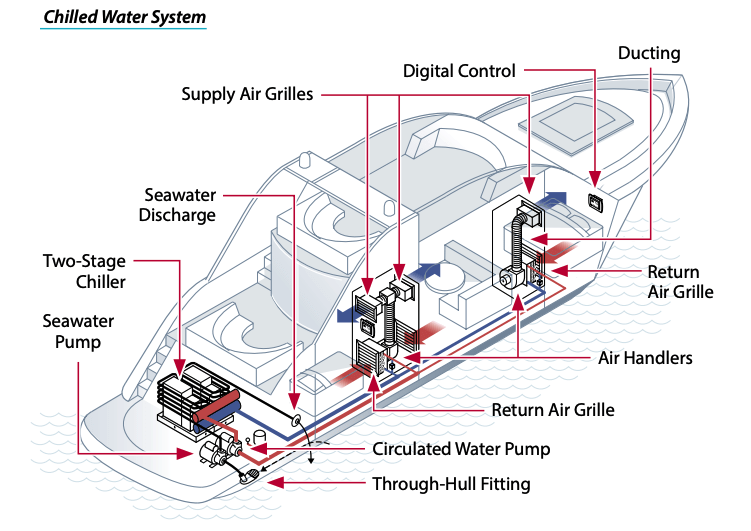
What is a Chilled Water Marine Air Conditioner?
A chilled water marine A/C system is capable of cooling many cabins using a water loop instead of refrigerant between the chiller and the air handlers. It consists of a chiller, located in the engine room, that cools (or heats) fresh water mixed with glycol (coolant or antifreeze), which is then pumped through an insulated piping loop out to air handlers located in the living spaces, where the cabin air is cooled (or heated). Chiller systems can be configured to provide an almost endless amount of BTUs. Marine Chiller systems are generally used on large boats and super yachts, due to their efficiency, flexible load management and reduced peak electrical load.
How Do You Size a Marine Air Conditioner?
To size a marine air conditioner, multiply the length and width of each cabin that will be cooled to determine the area in square feet or square meters. If one end of the cabin is narrower than the other, take your measurement in the middle. Using the table below, multiply the area of each cabin by the appropriate load factor to determine the required air conditioner capacity in BTUs. For example, if your boat is in a temperate climate and you are measuring in square feet, you would multiply a cabin in your below-deck area by 60, your mid-deck area by 90, or your above-deck area by 120.
| Climate | Below-Deck Load Factors |
Mid-Deck Load Factors |
Above-Deck Load Factors |
| Temperate* | 60 (sq. ft.) 645 (sq. m) |
90 (sq. ft.) 968 (sq. m) |
120 (sq. ft.) 1291 (sq. m) |
| Tropical** | 80 (sq. ft.) 968 (sq. m) |
120 (sq. ft) 1291 (sq. m) |
150 (sq. ft.) 1614 (sq. m) |
*Temperate: 95°F (35°C) air, 85°F (35°C) water, moderate humidity.
**Tropical: 105°F (41°C) air, 95°F (35°C) water, high humidity.
What is the Cost to Install Marine Air Conditioning?
There are many steps involved in adding air conditioning to a boat, and while each step isn’t necessarily difficult, it is time consuming. For the average marine air conditioner, you have to install a through hull and seacock for the cooling water, pump, condenser, ducting, grills, thermostat, condensation drain to the bilge, and another exit above the waterline for the water outlet. All of this should take approx. 20 hours at $90-$100/hr yard rate. And the unit itself runs on average anywhere from $1500 – $2500. Ballpark estimate for the cost to install marine air conditioning is around $3000-$4500.
Do Sailboats Have AC?

Sailboats have AC just like powerboats and yachts. An AC unit on a sailboat typically draws cabin air into a unit or air handler through a return air grill. A compressor cools the air down, either via refrigerant, or in the case of a chiller unit, cooling water, and then this cool air is blown back into the cabin through distribution ducts.
How Many Watts Does a Marine Air Conditioner Use?
You want to go with at least a 2000 watt quality marine generator if you want to add a marine air conditioner onboard. A Honda 2000 will not run most AC units. You’d need at the minimum a 3000 watt generator to run a 12000 BTU marine air conditioner. However, adding a soft-start to the A/C unit will allow you to drop the peak amperage drawn by up to 60% making easier usage of a small 2,000 watts portable generator.
How Many Amps Does a Marine Air Conditioner Draw?
Marine air conditioning systems are of the largest electrical amperage draws when you are underway, but use only modest AC current when connected to shore power. At the dock, a 5,000-16,000 Btu AC system could draw between 4 and 13 amps on running amps at 120V. When underway in a powerboat, these amperages are manageable.
What is Reverse Cycle Air Conditioning?
With Reverse Cycle Air Conditioning you can either cool your cabin during the summer or warm it up in the winter using the same marine AC unit. The basic working principle of any air conditioner is the transfer of heat from one element to another. In seawater-cooled marine air conditioners, heat is transferred from the cabin air to the refrigerant gas to the seawater. In heating mode, the refrigerant flow is reversed, and heat is transferred from the seawater to the refrigerant gas to then warm the cabin air. This selection is made by a reversing valve that is situated on the unit which is activated by an electric solenoid.
Looking to Install a New Marine Air Conditioner? Questions on Marine A/C? We Can Help
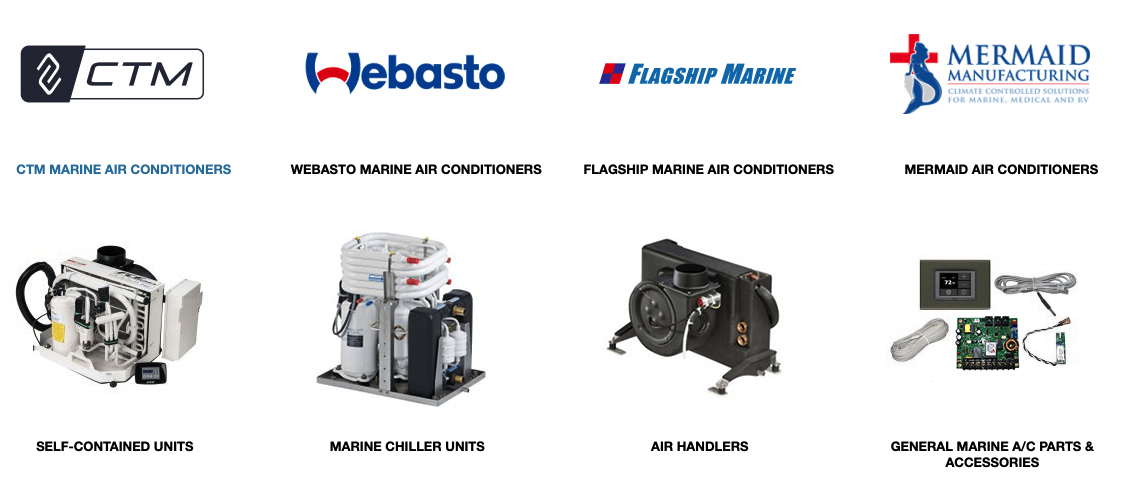
Hopefully this Marine Air Conditioning FAQ helped answer some of your commonly asked questions about marine AC. Here at Citimarine Store, one of our strongest product areas is marine air conditioning. Our staff includes several boaters, as well as marine AC specialists who have helped provide technical support on the installation of hundreds if not thousands of marine AC units over the past decade. We carry marine AC units from top brands, at the lowest prices possible. Free shipping on units under 150 lbs.
See here! Marine Air Conditioners
Have a good one!
Citimarine Store
3300 NW 112th Ave, #4
Doral, FL 33172
1-(800)-766-5256
CitimarineStore.com
–
Related:







8 Comments
I currently have 5 Cruisair FX16C-P AC units. If I replace the Cruisair units with CTM CX-16H units along with new evaporators, do I need to replace the copper lines?
Hi Jim,
No, you do not have to replace the copper lines. You only have to clean them thoroughly and make sure there is no residue left in the system. After that you can install the new condenser and evaporators, and can even use the same control/thermostat and temperature sensors that you previously had.
Can a chilled water ac inverter used fresh water as well as sea water
Hi Rodney,
Chilled water AC systems use both fresh and sea water. Freshwater circulates back and forth between the chiller and the air handlers through insulated piping or water hoses. Seawater circulates through the condenser via the seawater system. The heat transfers from the “heated” refrigerant, to the seawater, and pumped overboard along with all the original hot cabin air.
For more on how marine chiller systems work, please see here: https://citimarinestore.com/citiguide/marine-chiller-system-ideal-ac-system-for-yachts/
I have a cruiser 16,000 BTU air conditioner on my boat. The model number is STQ 16 U – 410 A – 7MR. I would like to power the air conditioner using a portable generator. I am looking at a pulsar 4000 peak 3200 or 30 703,000 running using LPG. Will that be enough to run the air conditioner? Thank you so much.
Hi John,
A 3,000 running watt generator on LPG will probably be borderline for a 16,000 BTU Cruisair unit, especially during compressor startup.
Your Cruisair STQ16U-410A-7MR likely draws around 10–12 amps while running, which is well within the generator’s continuous output. The challenge is the compressor startup surge, which can briefly spike much higher than the normal running load.
Without a soft-start device installed, many 16k BTU marine A/C systems can have difficulty starting reliably on a portable generator in the 3kW range, particularly on propane where generator output is slightly reduced compared to gasoline.
If the unit does NOT already have a soft starter, I would strongly recommend installing one (such as a Micro-Air EasyStart or similar). A soft starter dramatically reduces the startup surge and greatly improves the chances of successfully running the system from a portable generator like the Pulsar.
Also keep in mind:
The raw water pump adds additional load
Eco mode should be turned OFF during startup
High ambient temperatures increase startup demand
Long extension cords or undersized wiring can cause voltage drop and make startup harder
With a soft starter installed, there’s a good chance that generator could run the system successfully. Without one, it may trip the breaker or struggle to start the compressor consistently.
One very important safety note: never operate a portable generator near enclosed cabin areas, swim platforms, or open hatches due to the risk of carbon monoxide buildup.
Let us know how it goes for you!
I have a 16kw MarinAire bought 4 years ago. I replaced the compressor 2 years ago under warranty. The system had been running fine since. Im in a slip in south Florida and run the system continuously at 76 F, cleaning the raw water strainer once a week. Running on A/C mode seems more efficient than dehumidify.
Ive had the system descaled once with Barnacle Buster. How often should I descale this system?
Hi Sal,
Given that you’re in a South Florida slip and running the system essentially full-time, I’d generally recommend descaling about once a year as preventative maintenance. In some cleaner water conditions, you may be able to stretch it closer to every 2 years, but warm South Florida water tends to accelerate mineral buildup and marine growth inside the condenser coil.
You’re also correct that running in normal A/C mode is usually more efficient for continuous operation than dehumidify mode.
Cleaning the raw water strainer weekly is excellent maintenance, but scale and biological buildup can still slowly develop inside the condenser even with good water flow.
Typical signs that it’s time to descale include:
Reduced water flow from the discharge
Warmer supply air
Higher operating pressures
HPF (High Pressure Fault) alarms
The compressor working harder or running longer than normal
Since you already had the system descaled once and replaced the compressor a couple years ago, staying on an annual descaling schedule is probably good insurance for the long-term health of the system. Barnacle Buster is indeed a good product for this application, and making sure the system is thoroughly flushed afterward is important as well.
Hope this helps!